









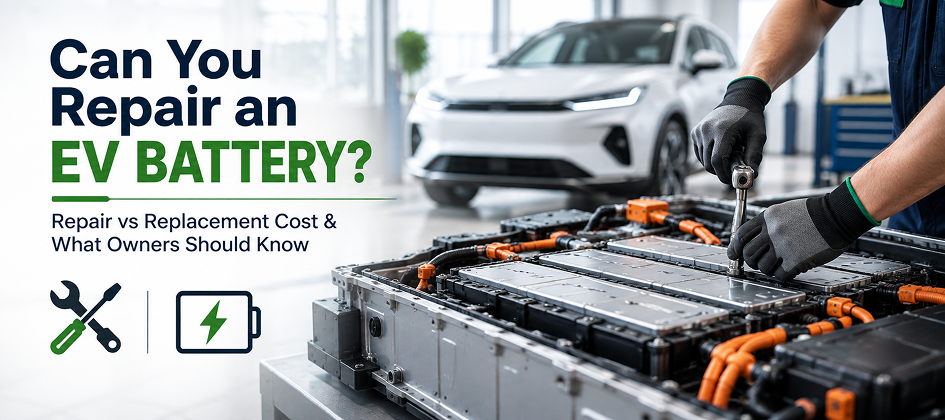
Yes, some EV battery problems can be repaired, but not every battery fault is repairable. The decision depends on the failed component, battery condition, safety, vehicle design, warranty, and repair cost. Component-level issues like BMS failure, wiring faults, or individual module degradation can often be repaired for a fraction of the cost of a full pack replacement. However, severe physical damage, widespread cell degradation, or thermal events require a complete battery replacement.
When electric vehicle (EV) owners face a sudden drop in range or a battery warning light, the immediate fear is often a bill for a complete battery pack replacement. In many cases, replacing the entire pack is unnecessary.
"EV battery repair" rarely means opening a sealed chemical cell to fix internal elements. Instead, it refers to diagnosing, servicing, or replacing isolated non-chemical or modular components within the high-voltage system. Modern EV battery packs are complex assemblies made of structural enclosures, cooling loops, electronic control boards, wiring harnesses, and multiple connected modules.
If a single module loses capacity or a sensor on the control board fails, the vehicle's Battery Management System (BMS) may shut down the pack or trigger a fault to protect the vehicle. Repairing or reconditioning that isolated component can often restore full functionality.
EV Battery Pack Layout:
Control & Support Layer: Battery Management System (BMS), Wiring Harnesses, & Cooling Loops
Power Layer: Modular Cells (Module 1, Module 2, Module 3, Module 4)
Whether a battery can be repaired depends on its architectural design. Some manufacturers build packs with accessible, serviceable modules, while others use "cell-to-pack" (CTP) or structural battery designs where cells are bonded directly into the chassis with structural adhesives, making module-level repair difficult or impossible.
Safety Warning: High-voltage EV batteries operate at potentials ranging from 400V to over 800V DC. Opening, probing, or attempting to repair an EV battery pack without certified high-voltage training, insulated tools, and specialised protective equipment creates severe risks of fatal electric shock, short circuits, and thermal runaway. Never attempt DIY repairs on a high-voltage battery system.
An EV battery pack is made of multiple electrical, mechanical, and thermal sub-systems. The table below outlines which components are typically repairable versus those that require replacement:
| Battery Component | Can It Be Repaired? | Typical Problem | Possible Solution |
| Battery Cells | Sometimes | Cell imbalance, localised capacity loss, internal short | Rebalancing, or isolated module/cell replacement |
| Battery Modules | Sometimes | Single module voltage drop or degradation | Individual module replacement or reconditioning |
| BMS (Control Board) | Often | Communication errors, blown fuses, software calibration faults | Component-level electronic repair, re-flashing, or board replacement |
| Wiring & Connectors | Often | Corrosion, loose busbars, damaged wiring harness | Connector cleaning, busbar re-torquing, or harness replacement |
| Cooling System | Often | Coolant leaks, pump failure, clogged thermal lines | Seal replacement, hose repair, or cooling pump replacement |
| Battery Enclosure | Depends | Minor puncture, surface rust, bracket damage | Inspection, sealing, structural bracket repair, or shield replacement |
| Entire Battery Pack | Depends | Structural failure, widespread degradation, thermal event damage | Full pack replacement or refurbishing |
Identifying the specific failure point helps determine whether a repair is viable:
Over thousands of kilometres, minor manufacturing differences cause individual cells or modules to charge and discharge at slightly different rates. If one cell drops below the safety threshold, the BMS restricts the entire pack's usable capacity.
Symptoms: Sudden drop in displayed range percentage, inability to charge to 100%, or premature power cut-offs.
Repair Strategy: Manual cell-balancing using diagnostic software or replacing the single weak module.
The BMS monitors cell voltages, currents, and temperatures. A blown internal fuse, damaged voltage sensor, or corrupted firmware can cause the BMS to report a pack failure even when the physical cells are completely healthy.
Symptoms: Immediate high-voltage error codes, refusal to accept a charge, or total vehicle shutdown despite a full battery.
Repair Strategy: BMS firmware re-calibration, fuse replacement, or replacing the BMS circuit board.
Vibration, humidity, and road debris can loosen or corrode internal busbars and high-voltage wiring harnesses.
Symptoms: Intermittent power loss, error codes triggered while driving over rough roads, or charging interruptions.
Repair Strategy: Cleaning corroded contacts, replacing damaged wiring harnesses, or re-securing internal busbars.
Liquid-cooled EV packs rely on pumps, valves, and heat exchangers to keep temperatures within safe limits. A failing coolant pump or small leak can cause localised overheating.
Symptoms: Frequent battery thermal warnings, thermal throttling (reduced acceleration), or reduced fast-charging speeds.
Repair Strategy: Flushing the cooling loop, replacing failed pumps or thermal control valves, and fixing external coolant hose leaks.
In modular packs, a single failed module can drag down the performance of the entire system.
Symptoms: Significant and permanent drop in total usable capacity while the rest of the pack parameters remain normal.
Repair Strategy: Swapping out the affected module with a matched, verified replacement unit.
While module-level repairs are cost-effective, certain scenarios make full replacement the only safe option:
Localised Faults (Repair Advised):
Single failed module
BMS or sensor fault
Loose connector or wiring issue
Severe Damage (Replacement Advised):
Structural pack crack or chassis damage
Thermal runaway or fire damage
Widespread degradation (state of health below 70%)
Severe Crash Damage: Structural distortion, cracks, or deep punctures to the main battery tray compromise the structural integrity and cell separation, posing an immediate short-circuit or fire risk.
Thermal Runaway or Fire Damage: Even localised thermal events compromise the structural, electrical, and chemical stability of neighbouring cells.
Extensive Water Intrusion: Submersion or severe water ingress causes widespread corrosion across high-voltage contacts, circuit boards, and cell terminals.
Widespread Internal Degradation: When an EV battery's State of Health (SoH) drops below 70% across all modules due to age and high mileage, replacing one module will not restore long-term range.
Structural / Bonded Battery Packs: Packs using cell-to-pack (CTP) designs bonded with structural polyurethane foam cannot be disassembled safely without destroying the adjacent cells.
Economic Unfeasibility: If diagnosing and replacing multiple modules approaches 60%–70% of the cost of a new or factory-refurbished battery pack, full replacement offers better long-term value and warranty coverage.
Comparing key factors helps determine the appropriate approach:
| Factor | Battery Repair | Battery Replacement |
| Upfront Cost | Significantly lower (often 10%–30% of replacement cost) | Higher capital expenditure |
| Downtime | 2 to 7 days depending on diagnostic complexity | 1 to 3 days (if the replacement pack is in stock) |
| Suitable For | Isolated BMS faults, sensor failures, single module drops | Structural damage, widespread ageing (<70% SoH), thermal damage |
| Pack Condition | Remaining cells and modules are healthy (>80% SoH). | Widespread cell ageing or severe physical damage |
| Warranty Impact | Third-party repairs may void the OEM battery warranty. | Comes with a new OEM or factory-refurbished warranty |
| Safety Risk | Requires thorough post-repair insulation and pressure testing | Factory-sealed pack minimises assembly risk. |
| Long-Term Value | Ideal for extending vehicle life by 3–5 years cost-effectively | Ideal for keeping an EV long-term with fresh range potential |
EV battery repair costs in India vary widely based on vehicle type, pack capacity, and the specific failure.
Vehicle Type & Segment: Electric two-wheelers use simpler, lower-voltage packs (48V–72V) that are faster to diagnose than 400V electric car systems.
Nature of the Fault: Replacing a thermal sensor or re-flashing a BMS costs significantly less than sourcing and balancing a replacement module.
Labour & Diagnostic Time: Locating micro-faults inside a sealed high-voltage enclosure requires specialised diagnostic equipment and skilled high-voltage technicians.
Authorised vs Independent Repair: Authorised service centres generally prefer module or full-pack swaps, whereas specialised third-party EV workshops perform board-level BMS repairs and isolated component fixes.
(Note: These estimates are illustrative industry averages for out-of-warranty repairs. Always obtain a diagnostic report and written quotation from an authorised centre or certified specialist.)
Electric Two-Wheelers (Scooters/Bikes):
BMS, harness, or connector repair: INR 3,000 to INR 8,000
Isolated module swap or cell balancing: INR 8,000 to INR 15,000
Electric Passenger Cars:
BMS, contactor, or cooling sensor repairs: INR 15,000 to INR 35,000
Single module replacement & balancing: INR 60,000 to INR 150,000
When repair is not feasible, full battery replacement is necessary. Battery replacement costs in India average INR 15,000 to INR 20,000 per kWh at authorised service centres.
Electric Scooters (2.5 kWh – 4 kWh pack):
Replacement Cost: INR 35,000 to INR 65,000
Refurbished OEM Options: Some manufacturers offer factory-refurbished packs for INR 12,000 to INR 18,000 with a limited warranty.
Entry-Level Electric Cars (19 kWh – 26 kWh pack, e.g., Tiago EV, Comet EV):
Replacement Cost: INR 3.0 Lakh to INR 4.5 Lakh
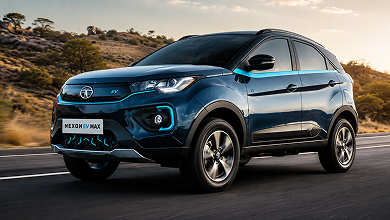
Mid-Size Electric Cars (30 kWh – 45 kWh pack, e.g., Nexon.ev, Windsor EV):
Replacement Cost: INR 4.5 Lakh to INR 7.5 Lakh
Long-Range / Premium EVs (50 kWh – 70+ kWh pack, e.g., MG ZS EV, Hyundai Ioniq 5):
Replacement Cost: INR 8.0 Lakh to INR 14.0+ Lakh
Core Buy-Back / Scrap Credit: Old battery packs retain high residual value for second-life applications (such as stationary solar storage). Returning the old pack to the OEM can yield a buy-back credit of INR 10,000 to INR 80,000+, depending on size and condition.
Labour & Testing Charges: High-voltage pack removal, mounting, coolant refill, and BMS recalibration typically add INR 5,000 to INR 25,000 in labour fees.
Use this evaluation framework to decide between repair and replacement:
Choose REPAIR when:
Diagnostics confirm the fault is isolated to the BMS, wiring, cooling, or a single module.
The overall battery pack's State of Health (SoH) remains above 80%.
The total repair estimate is less than 40% of the cost of a full battery replacement.
The repair is conducted by a certified facility providing a written warranty on the work.
Choose REPLACEMENT when:
Physical crash damage, water submersion, or a thermal event has compromised pack safety.
The battery shows widespread degradation (SoH under 70%) across all modules.
The pack uses non-serviceable cell-to-pack (CTP) structural designs.
Repair costs exceed 60% of a new or factory-refurbished pack's price.
Technically, individual cells within a module can be replaced. However, in professional automotive applications, repair centres replace entire modules rather than loose individual cells.
Battery Structure Hierarchy:
Cell (Single Unit) $\rightarrow$ Module (Group of Cells) $\rightarrow$ Pack (Complete Array)
Cell Matching & Resistance: A new cell mixed with older cells creates an internal resistance mismatch. The BMS will continuously struggle to balance the pack, reducing efficiency.
Factory Laser Welding: Automotive battery cells are joined using automated micro-laser welds or ultrasonic busbar bonds. Manual soldering generates excessive heat that can damage cell seals and internal separators.
Safety & BMS Recalibration: Mismatched individual cells increase the risk of thermal runaway during high-current fast charging.
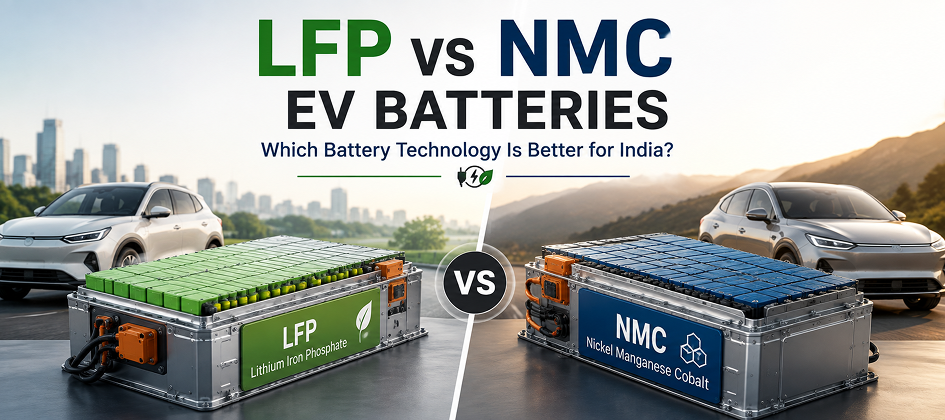
To learn more about the structural differences between lithium chemistries, read our comparison of LFP vs NMC EV batteries.
The economic and technical viability of battery repair varies significantly across EV formats:
| EV Type | Typical Battery Issues | Repair Considerations |
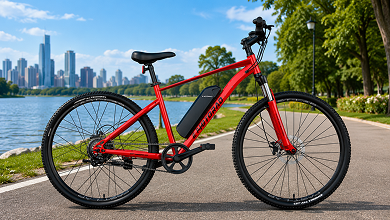
| Electric Scooter | BMS locks, thermal sensor failure, loose connector pins, moisture ingress | Smaller, lighter packs (10–25 kg). Modular design allows easier workbench testing and lower diagnostic costs. |
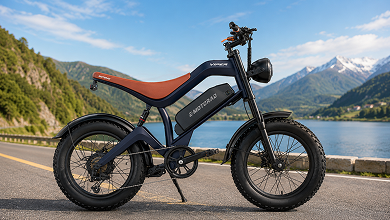
| Electric Motorcycle | High discharge wear, connector pitting, BMS imbalance | Medium-sized packs (3–6 kWh). Requires dedicated casing disassembly and balancing gear. |
| Electric Car | Module voltage drift, cooling loop leaks, high-voltage contactor failure | Heavy packs (200–500 kg). Requires specialised hydraulic lift tables, high-voltage isolation gear, and complex BMS diagnostics. |
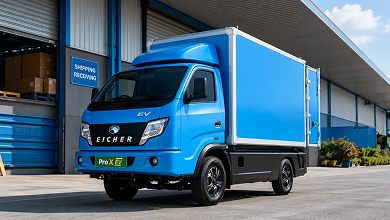
| Commercial EV | Accelerated cyclic degradation, structural tray wear | High usage demands minimal downtime. Fleet managers often prefer quick pack swaps or factory-refurbished modules. |
Recognising early warning signs allows you to address battery issues before they cause full vehicle breakdowns:
📉 Sudden Drop in Real-World Range: A noticeable decrease in range (e.g., losing 30% range overnight) indicates a failed module or cell imbalance rather than normal ageing.
⚡ Erratic Dashboard SoC Jumps: The battery percentage display jumps erratically (e.g., dropping from 40% to 15% within a single kilometre).
🔌 Charging Interruptions or Rejection: The vehicle prematurely stops charging at public DC fast chargers or refuses to initiate charging on home AC setups.
🐢 Persistent "Limp Mode" / Power Truncation: The vehicle frequently enters a reduced-power mode even when the battery display shows adequate charge.
⚠️ High-Voltage or BMS Error Codes: Warning icons or messages such as "Check EV System", "Battery Fault", or "High Voltage Error" appear on the digital cluster.
🌡️ Battery Overheating: The cooling fans run at maximum speed continuously during mild driving or slow AC charging.
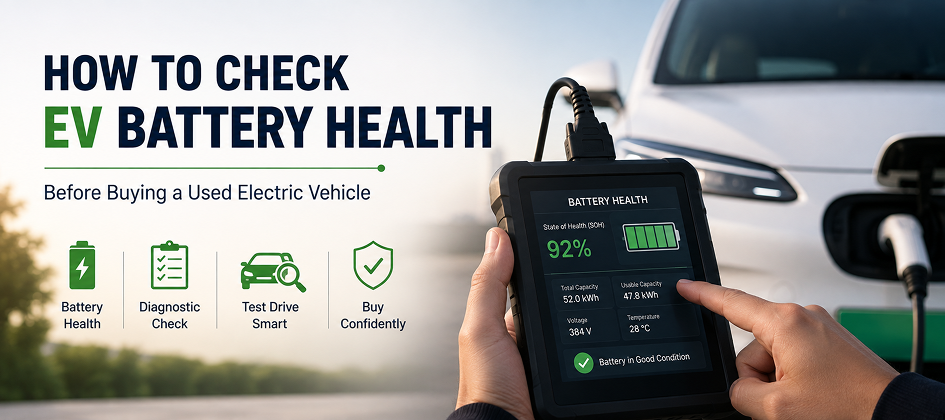
To distinguish between temporary range loss and permanent capacity drop, consult our guide on EV battery degradation in India.
Follow a systematic step-by-step diagnostic process before authorising repairs:
Scan OBD-II High-Voltage Error Codes: Have a technician connect an EV-compatible diagnostic tool to read active Diagnostic Trouble Codes (DTCs) from the BMS.
Examine BMS Cell Voltage Matrices: Review individual cell delta voltages. A healthy pack shows a tiny voltage variance (typically <20 mV) across all cells. A failing module will show a wider voltage gap under load.
Conduct a Real-World Capacity Test: Charge the vehicle to 100% and perform a controlled discharge test to measure total energy throughput (kWh) against factory ratings.
Inspect External Subsystems: Inspect cooling lines, pump operation, external high-voltage contactors, service plugs, and ground cables before opening the main pack casing.
Verify Factory Warranty Coverage: Check whether the issue is covered under the manufacturer's high-voltage battery warranty.
Obtain an Itemised Diagnostic Estimate: Request a written diagnostic breakdown detailing whether the issue is isolated to a sensor, BMS board, wire harness, or internal module.
Most EV manufacturers in India cover battery repairs or replacements under warranty, provided specific conditions are met.
Standard Warranty Durations:
Electric Cars: Typically 8 years or 160,000 km (whichever occurs first). Some manufacturers offer extended coverage up to 5 years / 125,000 km for mechanical and electrical components.
Electric Two-Wheelers: Typically 3 years to 5 years or 30,000 km to 50,000 km.
Health Threshold Guarantees: Warranties generally guarantee that the battery will retain at least 70% to 75% of its original capacity during the warranty term.
Common Warranty Exclusions:
Physical damage from underbody road impacts or accidents.
Water damage from driving through deep standing water beyond recommended wading depths.
Unauthorised battery modifications, third-party tuning, or opening the battery seal.
Prolonged neglect (e.g., leaving the battery at 0% charge for months).
For full details on owner rights and claim procedures, read EV Battery Warranty Explained.
If your EV's factory warranty has expired, deciding where to get service requires weighing several trade-offs:
| Option | Pros | Cons |
| Authorised OEM Service Centre | Genuine factory parts, calibrated diagnostic equipment, and a guaranteed warranty on new parts. | Higher labour rates; often recommend full pack replacements over component repairs. |
| Specialised Independent EV Repairer | Willing to perform component- and module-level repairs; lower overall repair costs. | Availability is limited to major urban centres; requires verifying technician qualifications. |
| Refurbished OEM Pack Exchange | Moderate cost; factory-balanced pack backed by a 1-year/15,000 km warranty. | Availability depends on manufacturer inventory. |
High-voltage battery repair carries significant safety risks:
High Voltage Risk: Operating between 300V and 800V DC poses severe shock hazards.
Short Circuit Risk: High-current potential can trigger arc flash hazards.
Thermal Event Risk: Damaged cells can release toxic gas or cause chemical fires.
Safety Rule: Never attempt to open, repair, or modify a high-voltage EV battery yourself. Always rely on certified technicians working in equipped facilities.
Before agreeing to an out-of-warranty repair, ask the service centre these questions:
What specific error code was logged, and what exact part failed? (Ensure they have identified whether it is a BMS, module, or sensor issue.)
What is the current State of Health (SoH) across the remaining unrepaired modules?
Is the proposed repair manufacturer-approved or performed to OEM safety standards?
Will this repair void any remaining vehicle warranties?
Will the repaired module be capacity- and voltage-matched to the existing pack?
What written warranty is provided on the new parts and labour?
What is the total written estimate, including diagnostics, parts, labour, and taxes?
Use this quick checklist to clarify your path forward:
Go with REPAIR if you check most of these boxes:
[ ] The battery diagnostic identifies an isolated fault (BMS, wiring, single module, or cooling pump).
[ ] The rest of the pack shows healthy, uniform capacity (>80% SoH).
[ ] The repair facility offers a written warranty on the repair work.
[ ] The total repair cost is significantly lower than a pack replacement.
Go with REPLACEMENT if you check most of these boxes:
[ ] The battery enclosure suffered severe physical impact, cracking, or water submersion.
[ ] Multiple modules show severe, widespread degradation (<70% SoH).
[ ] The battery uses non-serviceable cell-to-pack structural construction.
[ ] The vehicle manufacturer offers an affordable factory-refurbished pack exchange.
While electronic failures can happen unexpectedly, good habits reduce stress on your high-voltage system:
Avoid Deep Discharges: Try not to leave your EV sitting below 10% state of charge for extended periods.
Manage Fast Charging Heat: Avoid back-to-back DC fast-charging sessions on hot days if your vehicle uses an air-cooled pack.
Maintain the Cooling System: Keep coolant levels topped up and clear debris from front radiator grilles.
Drive Cautiously Over Obstacles: Use care on rough roads to prevent underbody impacts to the battery shield.
Address Warning Lights Promptly: Have minor warning icons inspected early before an isolated sensor issue causes wider module imbalances.
Keep Vehicle Software Updated: Install manufacturer software updates, which often include improved BMS thermal management algorithms.
Facing an EV battery issue does not automatically mean purchasing a brand-new battery pack. Modern EV battery systems are modular, and issues involving control electronics, cooling loops, or single modules can often be repaired safely at a fraction of the cost of full replacement.
When evaluating your options:
Always start with professional OBD-II diagnostics to pinpoint the specific fault.
Check your factory warranty status before authorising out-of-pocket expenses.
Prioritise safety: Never compromise on safety for minor cost savings if a pack has suffered structural or thermal damage.
By understanding your battery's condition and working with certified specialists, you can extend your EV's service life and make informed, cost-effective decisions.


Manage reminders, payment status, and renewal dates from one simple app.


Trusted by policyholders to track every renewal.