














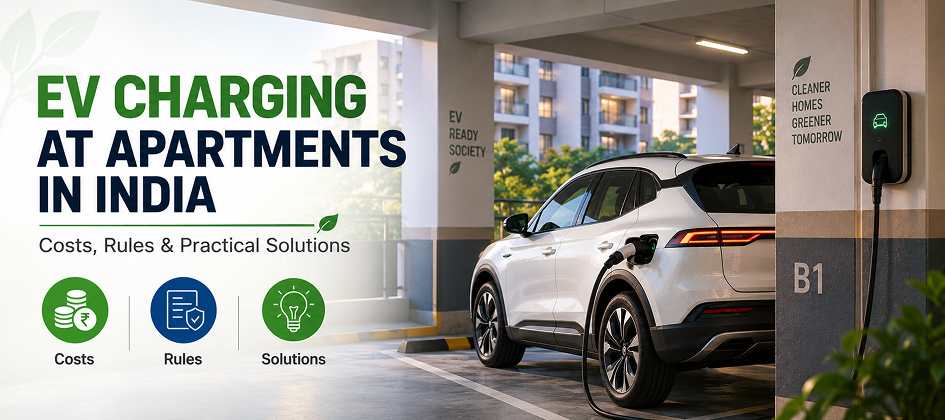
Buying an electric car or electric scooter in India is becoming increasingly popular. Lower running costs, quiet operation, and zero tailpipe emissions make EVs an attractive choice for daily city commuting.
However, for millions of urban Indians living in apartments, housing societies, or high-rise complexes in cities like Bengaluru, Mumbai, Delhi-NCR, Pune, Hyderabad, Chennai, and Ahmedabad, a fundamental question arises: "How do I charge my EV when I live in an apartment?"
Unlike independent house owners who can easily plug into a ground-floor garage, apartment residents share electrical infrastructure, parking bays, basements, and common amenities. Installing a charger involves navigating parking rights, society permission, long cabling routes, safety standards, and electricity billing.
This detailed guide explains how EV charging at apartments in India works—covering common challenges, step-by-step approval processes, estimated installation costs, electricity billing methods, safety protocols, and practical solutions for those with or without dedicated parking.
Charging an electric vehicle at home is straightforward when you have a private driveway. In an apartment complex, several physical, administrative, and technical constraints must be managed:
Lack of Dedicated Parking: Many older housing societies do not assign fixed, legal parking slots to individual residents. Cars are parked in open, unassigned, or common areas.
Distance From the Electricity Meter: Meter rooms are usually located on the ground floor or in specific electrical shafts. If your allotted parking slot is deep in a multi-level basement or far across an open compound, running dedicated cables becomes complex and costly.
Limited Electrical Sanctioned Load: Every building and apartment unit has a sanctioned electrical load limit (e.g., 3 kW, 5 kW, or 10 kW). Plugging in a high-capacity EV charger without checking your total household load could trip the main circuit breaker.
Society Permission and Rules: Managing committees and Resident Welfare Associations (RWAs) may hesitate to grant permission due to safety fears, aesthetic concerns over loose cables, or a lack of a formal charging policy.
Billing and Cost Disputes: If a charger uses common society power, neighbours may worry that their maintenance fees are subsidising another resident’s vehicle.
Basement Safety Concerns: Societies often raise concerns regarding electrical overload, short circuits, or fire safety in underground basement parking garages.
Multiple EV Owners: As more residents buy EVs, having dozens of individual cables running across electrical ducts can create clutter and overload the transformer if unmanaged.
Yes, you can charge an EV while living in an apartment in India. However, the exact method depends on your parking arrangement, the property type, society regulations, and local electricity distribution company (DISCOM) norms.
Your options generally fall into four categories:
Flat Owner With Dedicated Parking: This is the simplest situation. With approval from your society, a licensed electrician can draw a dedicated cable from your individual flat meter or a newly applied EV meter directly to your allocated parking slot. Options include a private 15A socket for scooters and slow car top-ups or a dedicated AC wall-box charger.
Tenant Living in an Apartment: Tenants can charge EVs, but they need written consent from the flat owner (landlord) and formal permission from the society managing committee before making modifications to electrical panels or running new cables.
Resident Using Common Parking: If parking slots are unallocated or rotated, installing a personal charger at a single spot is rarely practical. In these cases, a shared, society-managed community charger is usually the best solution.
Resident Without Any Fixed Parking Space: Residents who park on public streets or unassigned outdoor spots can use portable charging options for electric scooters (with removable batteries), rely on nearby public fast-charging networks, or use workplace chargers.
Disclaimer: While government frameworks encourage residential charging, exact procedures, electricity tariffs, NOC requirements, and safety guidelines vary by state, DISCOM, and individual housing society bye-laws. Always confirm requirements with your local authorities and society committee before installing equipment.
Different vehicles and parking layouts require different charging approaches:
| Charging Solution | Best For | Key Advantages | Key Limitations |
| Normal 15A Socket | Electric scooters, 2-wheelers, and low-mileage emergency car top-ups | Low setup cost; uses standard heavy-duty wiring | Slow charging speed; requires dedicated wiring check and weatherproof enclosure |
| Dedicated AC Wall-Box Charger | Electric car owners with fixed, allocated parking slots | Faster charging (3.3 kW to 7.2 kW+); built-in safety features; convenient overnight use | Requires society NOC, dedicated cable run, and potential electrical load enhancement |
| Shared Society Charging Station | Housing societies with multiple EV owners or common parking | Single infrastructure serves multiple residents; automated app-based usage and billing | Requires society investment, space allocation, and vendor management |
| Public Charging Station | Residents without private parking or home charging access | High-speed DC charging; no home installation or permission needed | Higher cost per unit (kWh); travel time to station; potential waiting queues |
| Workplace Charging | Daily office commuters | Convenient charging while working; reduces home electricity load | Dependent on employer policy and charger availability |
| Portable Industrial Charger | Selected EV users with heavy-duty approved sockets | Flexible; can be carried in the vehicle trunk | Requires a correctly grounded, industrial-rated socket at the parking spot |
If you have an assigned parking space, you can usually install a dedicated EV charger by following a step-by-step approval and installation process:
Step 1: Confirm Official Parking Allocation — Check your allotment letter or property purchase deed to confirm that the parking bay is legally assigned or designated for your exclusive use.
Step 2: Site & Feasibility Inspection — Hire a qualified electrician to assess the distance from your meter, cable routing paths, sanctioned load, and earthing quality.
Step 3: Submit Written Request to Society/RWA — Apply for a No Objection Certificate (NOC) by providing charger specifications, cable routing details, and contractor compliance info.
Step 4: Check Sanctioned Load & Apply to DISCOM — Apply for a load enhancement or a separate EV meter if installing a higher capacity charger (e.g., 7.2 kW AC wall-box).
Step 5: Professional Installation — Ensure installers use dedicated armored copper cables, proper MCB, 30mA RCBO, Surge Protection Devices (SPD), and grounding.
Step 6: Testing & Final Commissioning — Verify earthing resistance, RCD tripping, and charger performance prior to daily use.
Safety Warning: Never run temporary extension cords, loose wires across driveways, or unapproved cables from high-rise flat balconies down to ground parking. These setups pose severe fire, tripping, and shock hazards and violate building safety norms.
The cost of installing an EV charger in an apartment complex varies based on charger capacity, cabling distance, electrical infrastructure, and labor.
Charger Hardware: Smart AC wall-boxes with Wi-Fi, RFID, or app control cost more than basic plug-and-charge units.
Cable Length and Type: Armored copper cables (e.g., 6 sq mm to 10 sq mm) form a major part of the cost if your meter room is far from your parking bay.
Electrical Safety Components: Dedicated MCBs, 30mA Type-A RCBOs, SPDs, weatherproof enclosures, and earthing pits.
Labor and Civil Works: Cable tray installation, wall drilling, conduit fitting, and core-cutting through walls or floors.
Metering & Load Upgrades: DISCOM fees for load enhancement or installing a separate meter connection.
| Component / Requirement | Estimated Cost Range (INR) | Key Considerations |
| Heavy-Duty 15A Socket Setup | INR 2,500 – INR 7,000 | Includes industrial socket, MCB, weatherproof box, and short cable run. |
| 3.3 kW AC Slow Charger (Hardware) | INR 12,000 – INR 25,000 | Suitable for two-wheelers and overnight slow charging for cars. |
| 7.2 kW AC Fast Wall-Box (Hardware) | INR 30,000 – INR 60,000 | Charges most electric cars fully in 6–8 hours; often bundled with vehicle purchases. |
| Armored Cabling & Conduit (Per Meter) | INR 150 – INR 350 / meter | Depends on cable thickness (e.g., 6 sq mm vs 10 sq mm copper) and tray requirements. |
| Electrical Safety Accessories (RCBO/SPD) | INR 3,500 – INR 8,000 | Essential protection against earth leakage and voltage surges. |
| DISCOM Load Enhancement / New Meter | INR 2,000 – INR 10,000+ | Official utility application and security deposit fees set by state DISCOMs. |
| Total Typical Installation Cost (Average) | INR 15,000 – INR 65,000+ | Varies primarily based on total cabling distance from meter room to parking spot. |
Calculating your monthly charging cost involves a straightforward formula:
Charging Cost (INR) = Electricity Consumed (kWh) × Electricity Tariff Rate (INR per kWh)
Vehicle: Compact Electric Car (40 kWh Battery Pack)
Monthly Driving Distance: 1,200 km
Real-world Efficiency: Approx. 0.14 kWh per km
Monthly Energy Required: 1,200 km × 0.14 kWh/km = 168 kWh (Units)
Assumed Domestic Tariff: INR 8.00 per unit (kWh)
Estimated Monthly Electricity Cost: 168 Units × INR 8.00 = INR 1,344 per month
Charging Losses: Energy transfer is not 100% efficient. Due to thermal losses during AC-to-DC conversion, grid power draw is roughly 10% to 15% higher than nominal battery capacity.
Slab Rates: In many Indian states, domestic electricity tariffs are tiered. Adding 150–300 units of EV charging to your flat’s existing bill may push consumption into a higher cost slab.
EV-Specific Tariffs: Some state DISCOMs offer dedicated EV charging connections with fixed single-part tariffs or Time-of-Day (ToD) discounts for off-peak overnight charging.
To avoid billing disputes between residents and housing society management, choose a clear, transparent metering method:
Option 1: Direct Connection to Flat Meter: Direct connection from the resident's flat meter. Consumed electricity is billed directly on the resident's regular domestic DISCOM bill.
Option 2: Dedicated EV Sub-Meter: A certified digital sub-meter records charging units from the common board. The resident reimburses the RWA based on monthly meter readings.
Option 3: Separate Utility EV Meter: A new official utility meter installed specifically for EV charging, billed under state EV tariff rates.
Option 4: Smart App-Based Community Charging: App-managed shared society charger where users pay per session via UPI or wallet automatically.
Before starting installation, request written permission or an NOC from your RWA or managing committee. Key points to review together include:
Approved Cable Path: Agreement on cable tray routes in basements, risers, and common corridors.
Safety Equipment: Confirmation that the installation includes certified protective gear (MCB, RCBO, SPD, and proper earthing).
Meter & Billing Method: Clear documentation showing who pays for the electricity and how consumption will be measured.
Maintenance Responsibility: Written agreement that maintenance, repairs, and eventual removal of the personal charger are the owner's responsibility.
Contractor Access: Permission for licensed technicians to access electrical meter rooms and common areas during installation.
The Indian government actively encourages residential EV adoption through updated central policies and guidelines:
Ministry of Power Guidelines: The Ministry of Power (MoP) guidelines explicitly include Group Housing Societies, stating that residents may install private charging stations in their designated parking spaces and obtain electricity connections from DISCOMs.
Model Building Bye-Laws: Revisions by the Ministry of Housing and Urban Affairs (MoHUA) recommend that new residential developments make at least 20% of their parking capacity EV-ready with adequate power distribution infrastructure.
De-licensed Activity: Operating an EV charging station does not require a separate license, provided equipment complies with Central Electricity Authority (CEA) safety requirements and BIS standards (e.g., IS 17017).
Judicial Precedents: High Courts in India have observed that residential societies should not arbitrarily deny permission for EV charger installation in designated parking spaces when safety and electrical compliance requirements are met.
Important Note: Central guidelines serve as an overarching policy framework. Specific implementation rules, NOC timelines, and tariff structures are governed by state electricity regulatory commissions (SERCs), local municipal bodies, and individual society bye-laws. Always check the latest local regulations.
Charging an electric vehicle in an underground or basement garage is safe when installed according to Central Electricity Authority (CEA) safety guidelines:
Use Certified Equipment: Install chargers certified under Bureau of Indian Standards (BIS / IS 17017). Avoid uncertified imports or DIY wiring.
Install Protection Devices: Every circuit must include an MCB (overcurrent protection), a 30mA RCBO/RCD (earth-leakage protection), and a Surge Protection Device (SPD).
Ensure Robust Earthing: Shock protection systems depend on low-resistance, properly tested earthing circuits.
Conduit and Cable Protection: Basement cables should be enclosed in fire-retardant conduits or heavy-duty trays, elevated off the ground, and routed clear of water pipes and vehicle movement.
Maintain Fire Safety Standards: Keep charging areas clean, ensure adequate basement ventilation, avoid blocking driveways, and maintain accessible fire extinguishers nearby.
If you live in an apartment without an allocated parking bay, you can still charge an EV using these practical alternatives:
Shared Community Charging Bays: Work with your society committee to install 2 to 4 smart, app-based chargers in visitor or common parking areas that any resident can reserve.
Electric Scooters With Removable Batteries: Many electric two-wheelers feature portable battery packs that can be detached and carried upstairs to charge safely inside your flat using a standard wall socket.
Workplace Charging: Use charging points installed at your office or workplace garage during working hours.
Public Charging Hubs: Rely on nearby commercial fast-charging hubs located at shopping malls, fuel stations, or public parking facilities.
Shared Time-Slots: Coordinate with neighbors who own dedicated chargers to share access during off-peak hours.
| Apartment Scenario | Recommended Practical Solution | Primary Action Step |
| Dedicated parking near meter room | Private AC Wall-Box (3.3 kW or 7.2 kW) | Apply for society NOC; hire a licensed electrician to run a short cable. |
| Electric scooter with fixed parking | Weatherproof 15A Industrial Socket | Install a dedicated heavy-duty socket with an MCB and sub-meter/flat connection. |
| Common / Open unallocated parking | Shared Society EV Charging Station | Propose a vendor-managed, app-driven community charger to the RWA. |
| Multiple EV owners in society | Smart Load-Balanced Community Station | Partner with an EV charging network provider (CPO) to manage load and payments. |
| Older building with limited power capacity | Professional Load Feasibility Study | Assess building headroom first; consider slow AC charging or load enhancement. |
| Tenant with medium-term lease | Smart Portable Charger or Shared Bay | Get written owner approval or use shared society charging bays. |
| Parking bay far from meter room (> 50m) | High-Gauge Cable Run or New DISCOM Meter | Request a technical cable sizing study or check for a nearby common panel. |
To streamline approvals and avoid disputes, housing society committees and RWAs should establish a clear, written EV charging policy:
Standardized Application Process: Provide a simple NOC request form with a defined approval timeline (e.g., 7 to 14 days).
Technical & Safety Standards: Require all installations to use BIS-certified equipment (IS 17017), dedicated circuits, RCBO protection, and licensed electricians.
Cable Routing Guidelines: Specify approved electrical shafts, ceiling trays, and conduit standards to maintain clean building aesthetics.
Billing Principles: Ensure all electricity costs are borne directly by the EV owner via flat meters, sub-meters, or app payments. No common society maintenance funds should be used for private charging.
Future Expansion Planning: Designate specific areas or transformer capacity for future shared charging infrastructure as EV adoption grows within the society.
Understanding the differences between two-wheeler and four-wheeler charging helps residents select the right infrastructure:
| Feature | Electric Two-Wheelers (Scooters) | Electric Four-Wheelers (Cars) |
| Battery Size | 2.5 kWh – 4 kWh | 25 kWh – 80+ kWh |
| Standard Charger | 500W – 1.5 kW portable charger | 3.3 kW – 7.2 kW AC wall-box |
| Socket Requirement | Standard 15A heavy-duty socket | Dedicated industrial socket or wall-box unit |
| Charging Time | 3 to 5 hours | 6 to 10 hours (AC slow/fast home charging) |
| Hardware Cost | Low (socket setup or portable unit) | Moderate to High (AC wall-box hardware) |
| Cable / Circuit Needs | Standard 2.5 sq mm copper wire | 6 sq mm to 10 sq mm armored copper cable |
| Apartment Setup | Very simple; option for removable batteries | Requires allocated parking and cabling planning |
Before installing an EV charger in your apartment, run through this final checklist:
[ ] Verify Parking Allocation: Confirm you have legal or official rights to your parking bay.
[ ] Inform Society / RWA: Submit a written request and obtain formal approval/NOC.
[ ] Inspect Electricity Meter Location: Measure the cabling distance from your meter room to the parking spot.
[ ] Check Sanctioned Power Load: Verify if your flat's load limit can handle your intended charger.
[ ] Hire a Licensed Electrician: Avoid uncertified DIY installations.
[ ] Select a Certified Charger: Ensure hardware meets BIS (IS 17017) standards.
[ ] Plan Cable Routing: Ensure cables are housed in fire-retardant conduits or cable trays.
[ ] Install Safety Equipment: Confirm inclusion of a dedicated MCB, 30mA RCBO, SPD, and proper earthing.
[ ] Finalize Billing Setup: Confirm whether consumption will run through your flat meter, a sub-meter, or an app.
[ ] Store Documentation: Keep the society NOC, installation invoice, warranty details, and safety compliance certificates on file.
Charging an electric vehicle while living in an apartment in India is practical and manageable with the right approach. Whether installing a dedicated AC wall-box in an allocated basement slot or setting up shared community charging bays for the whole society, planning ahead makes all the difference.
By obtaining formal society approval, conducting a professional site assessment, using certified protective gear, and setting up transparent metering, apartment residents can enjoy the convenience and savings of home EV charging. Always verify current regulations with your local DISCOM, managing committee, and municipal authorities before starting work.
Explore EV specifications, charging guides, battery details, and running cost calculators on eVehicals.com.




Manage reminders, payment status, and renewal dates from one simple app.


Trusted by policyholders to track every renewal.