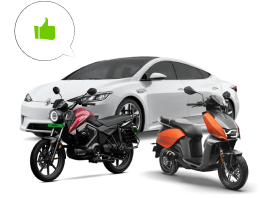


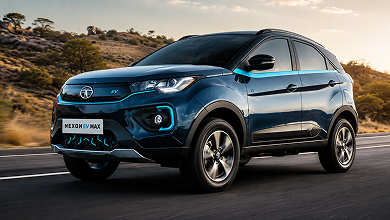


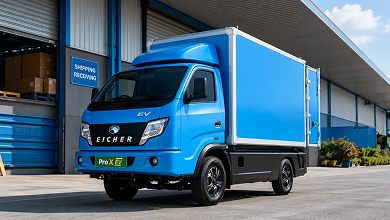








Buying a used electric vehicle (EV) in India, whether it is an electric car, scooter, bike, autorickshaw, delivery van, or commercial cargo loader, can significantly lower your upfront purchase cost while keeping daily running expenses low. However, the high-voltage or traction battery pack remains the single most critical and expensive component in any electric drivetrain.
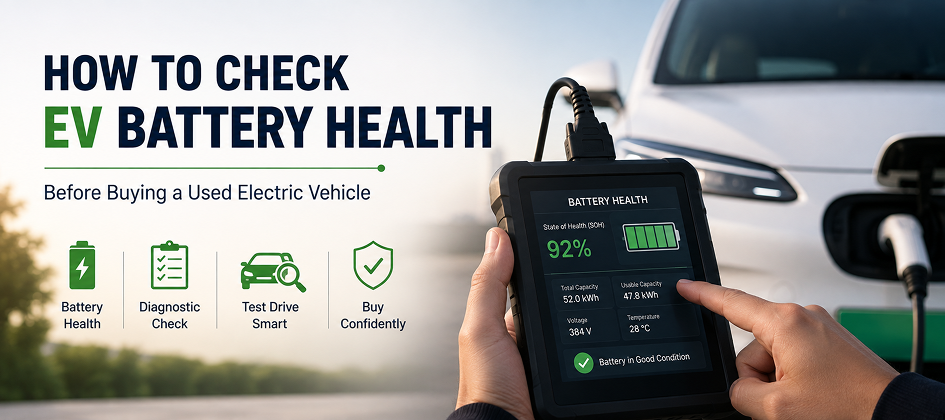
If you are wondering how to check EV battery health before buying a pre-owned electric vehicle, the most important rule is never to rely solely on the battery percentage displayed on the dashboard. Assessing battery health requires a combination of diagnostic reports, real-world range evaluation, charging tests, warranty verification, error code checks, and a professional technician's inspection.
To properly evaluate a used EV's battery, you must look beyond the instrument cluster's State of Charge (SoC). While the SoC simply indicates how much energy is currently stored in the battery, it does not reveal the underlying condition or maximum capacity of the battery cells.
USED EV BATTERY EVALUATION FRAMEWORK
Diagnostic Report (OBD / BMS Scan)
State of Health (SoH) Evaluation
Real-World Range Test Drive
Charging System Performance Check
Battery Warranty & Exclusions Check
Dashboard Warning Messages Inspection
Official Service & Repair History
Qualified Professional EV Inspection
Relying on a single metric can be misleading. Combining a digital EV battery diagnostic test with practical test-driving and document verification gives you a complete, transparent picture of the vehicle's battery condition before you make a financial commitment.
Understanding the distinction between battery charge and overall battery health is essential when evaluating a second-hand EV in India.
| Parameter | State of Charge (SoC) | State of Health (SoH) |
| Meaning | Current energy level (%) | Remaining overall capacity (%) |
| Behaviour | Changes constantly with use | Degrades slowly over time |
| Analogy | Like fuel gauge level | Like fuel tank size |
Battery Charge / State of Charge (SoC): Refers to the current fuel level of the battery pack. An SoC of 100% simply means the battery is charged to its maximum current limit, regardless of whether that maximum limit has decreased over time.
Battery Health / State of Health (SoH): Represents the battery pack's total usable energy capacity and condition compared to when it left the factory floor.
A Simple Analogy: Imagine a 10-litre water bottle. When brand new, filled to 100%, it holds 10 litres. After years of heavy use, sediment builds up and the bottle can physically only hold 8 litres. When you fill this aged bottle completely, its "charge level" is 100%, but its "health/usable capacity" is 80% relative to its original state.
Evaluating used EV battery health is vital because the battery dictates nearly every aspect of daily vehicle ownership:
Driving Range: Usable energy capacity determines how far you can travel between charging stops.
Charging Behaviour: A healthy battery pack accepts charge linearly and predictably without overheating or triggering system cutoffs.
Ownership Cost: Understanding battery condition prevents unexpected repair costs after purchase.
Warranty Coverage: Verifying that the battery health falls within acceptable operational parameters ensures manufacturer warranty coverage remains valid.
Resale Value & Confidence: A verified battery condition gives you peace of mind and pricing transparency during resale negotiations.
While battery health is a central consideration, it is only one component of a comprehensive used EV inspection, which should also cover suspension, tyres, braking systems, high-voltage wiring, and onboard electronics.
The most conclusive method for evaluating electric car battery health or commercial vehicle battery status is obtaining an official diagnostic scan.
Diagnostic Insights: OEM diagnostic tools read data directly from the Battery Management System (BMS), displaying cell-level voltage balances, historical temperature spikes, charging cycles, and persistent fault codes.
Where to Get It: Request the seller to accompany you to an authorised brand service centre or certified EV technician to generate a fresh diagnostic report.
Where supported by the vehicle's onboard software, review the State of Health (SoH) parameter.
Understanding SoH: SoH is expressed as a percentage representing the remaining usable capacity relative to factory specifications.
Context Matters: Avoid using universal thresholds (such as claiming any value below a fixed percentage is unsuitable). SoH must be interpreted in context with vehicle age, overall mileage, climate, and battery chemistry (such as Lithium Iron Phosphate [LFP] vs. Nickel Manganese Cobalt [NMC]).
Performing a practical range test drive helps verify EV battery condition under actual operating conditions.
$$\text{Estimated Range} = \left( \frac{\text {Distance Travelled}}{\text{SoC Percentage Consumed}} \right) \times 100$$
Example: 30 km driven using 20% SoC gives an estimated total range of 150 km.
Before the Drive: Record starting SoC percentage, displayed range estimate, odometer reading, driving mode, and ambient temperature.
During the Drive: Drive a mix of urban traffic and open roads (20–30 km), maintaining normal air conditioning or heating usage and regular speeds.
After the Drive: Calculate the real-world energy consumption rate against the percentage drop in SoC.
Note: Real-world tests offer a practical indication, not a calibrated laboratory capacity assessment.
A complete used electric vehicle battery check requires testing both slow and fast charging routines.
Inspection Steps: Connect the vehicle to a standard AC charging point and a public DC fast charger (if supported). Confirm that the charging connector locks securely, charging begins without delay, and no high-temperature or power-reduction warnings appear.
Factors Influencing Speed: Charging rate is naturally regulated by ambient temperature, current SoC level, charger power output, and thermal limits set by the BMS. Do not judge overall battery health based solely on temporary charging speeds.
Reviewing the active EV battery warranty protects you against unexpected failures.
Verify active coverage period and remaining mileage.
Confirm transferability guidelines with the OEM.
Check for required routine service compliance logs.
Inspect for voiding triggers (such as unauthorised electrical accessories).
Contact an authorised dealer with the Vehicle Identification Number (VIN) to verify warranty transferability and ensure prior ownership did not void coverage through unrecorded servicing or unauthorised modifications.
Turn the key or power button on to inspect the instrument cluster status.
What to Look For: Watch for yellow or red high-voltage fault icons, battery temperature alerts, or "reduced power" turtle-mode indicators.
Next Steps: A warning icon does not automatically mean total battery failure—it may indicate a sensor glitch, auxiliary 12V battery failure, or thermal regulation fault. Require a professional diagnostic scan before proceeding.
Ask the seller for complete service records and repair invoices.
Document Trail: Look for software updates applied to the BMS, high-voltage coolant flushes, battery recall completions, and past diagnostic logs. A clear service trail shows that the high-voltage system was maintained according to OEM guidelines.
For high-value pre-owned electric vehicles, schedule an independent pre-purchase inspection at an authorised service outlet or specialised EV garage.
Inspection Scope: Technicians evaluate the underbody battery casing for physical impacts, run OBD-II diagnostic scans, check high-voltage wiring insulation, and verify auxiliary battery performance.
Evaluating used EV battery check before buying requirements depends on the vehicle segment:
Focus on high-voltage battery SOH, CCS2 fast-charging capability, active factory warranty balance, BMS firmware updates, and underbody protection plate condition.
Check usable range in top speed/performance modes, inspect portable charging adapter cables, verify battery detachment/swapping mechanism condition (if applicable), and look for instrument cluster error codes.
Inspect drive-motor thermal behaviour, battery connector pins for corrosion or wear, real-world range under varied terrain, and acceleration consistency across different SoC levels.
Evaluate commercial daily operating range, thermal stability under heavy passenger loads, charge retention over multiple shifts, charger socket durability, and local battery supplier replacement availability.
Assess daily payload-dependent range drops, historical commercial mileage logs, fleet maintenance records, DC fast-charging frequency logs, and structural battery frame integrity under heavy loads.
Keep an eye out for these red flags during your pre-owned vehicle evaluation:
Unexpectedly large range reduction compared to original manufacturer estimates.
Repeated charging errors or sudden cutoffs during standard AC or DC charging sessions.
Persistent battery warning messages or high-voltage fault lights on the cluster.
Rapid, non-linear drops in SoC (e.g., dropping instantly from 30% to 10% under light acceleration).
Noticeable performance reduction or frequent unexpected entry into limp/turtle mode.
Missing service records or long unrecorded intervals in battery maintenance.
Unclear or non-transferable warranty status.
Evidence of undocumented battery casing repairs, uncertified sealant applications, or physical damage.
Before finalising your inspection, ask the seller these direct questions:
Has the battery pack or any cell module ever been repaired or replaced under warranty?
Is the original factory battery and motor warranty active, and can it be officially transferred?
Can you provide an official battery diagnostic/SoH report from an authorised service centre?
Where has the vehicle been routinely serviced, and are service records available?
Has the vehicle ever experienced charging interruptions, port locking issues, or battery fault warnings?
What is the average real-world range you achieve on a full charge with air conditioning/heating?
Is the original portable home charging cable and wall box hardware included in the sale?
How was the vehicle primarily charged—via home AC slow charging or commercial DC fast chargers?
Are you willing to accompany me to an authorised service outlet for a pre-purchase diagnostic scan?
Follow this systematic step-by-step evaluation flow when inspecting a used electric car in India or electric two-wheeler:
Step 1: Document Verification — Verify RC, service history logs, insurance, and battery warranty terms.
Step 2: Initial SoC & Range Recording — Note starting battery percentage, displayed range, and total odometer reading.
Step 3: Instrument Cluster Check — Power on the vehicle; verify all high-voltage warning lights clear normally.
Step 4: Physical & Cable Inspection — Inspect the charging port, pins, portable cables, and underbody battery casing.
Step 5: Test Drive Initiation — Drive 20–30 km across city and highway conditions while running climate control.
Step 6: Consumption Calculation — Calculate real-world km per percentage of battery consumed.
Step 7: Charging System Test — Plug into AC (and DC, if applicable) charger to verify handshake and charging flow.
Step 8: BMS Diagnostic Scan — Obtain official OBD diagnostic output at an authorised service centre.
Step 9: Professional Technician Review — Have a certified technician inspect high-voltage insulation and underbody plates.
Step 10: Final Payment Decision — Proceed with purchase only after all diagnostic, range, and legal checks pass.
Yes, but only to a limited extent.
Personal Checks (No Tools Required): Displayed range and SoC, real-world range consumption calculation, basic AC charging function, visual cluster error inspection, and physical casing damage checks.
Professional Diagnostics (Tools Required): Certified SoH percentage, individual cell voltage balance, historical BMS fault logs, high-voltage safety insulation test, and firmware version verification.
Safety Note: Never attempt to open high-voltage battery enclosures, dismantle cell modules, or probe orange high-voltage cables yourself. High-voltage DC systems carry severe electrical risks and must only be handled by trained professionals.
Fast charging does not automatically destroy an electric vehicle battery. Modern EVs use intelligent BMS protocols to regulate energy flow and manage temperatures during DC fast charging.
Thermal Control: Active cooling systems keep cell temperatures within safe thresholds during fast charging.
Usage Frequency: While routine fast-charging in extreme ambient heat may accelerate wear over time, standard fast-charging within BMS parameters remains safe.
Evaluating a vehicle's overall service history, battery chemistry, and thermal management health is more useful than assuming fast charging caused severe damage.
Vehicle mileage is only one factor influencing battery condition. An EV's battery condition depends on a combination of age, overall kilometres driven, charging habits, operating climate, and BMS thermal management efficiency.
A high-mileage EV that was slow-charged overnight in moderate temperatures can show better battery health than a low-mileage EV frequently subjected to fast-charging in extreme heat or left discharged at 0% for extended periods. Do not rely on odometer readings alone to determine battery condition.
Battery condition directly impacts buyer confidence and second-hand market pricing. An electric vehicle with a documented, healthy battery pack and active warranty coverage retains a higher portion of its value than one with unverified health or heavy range drop.
For a deeper dive into overall vehicle value retention trends, depreciation rates, and market projections across Indian vehicle segments, read our comprehensive guide: Electric Vehicle Depreciation in India (2026): Resale Value After 3–5 Years Explained.
When evaluating an out-of-warranty pre-owned EV, research potential future battery maintenance or replacement costs. Total expense depends on:
Vehicle segment and battery size (kWh capacity).
Chemistry type (LFP, NMC, etc.).
Availability of individual cell/module replacement versus whole pack replacement.
Manufacturer support and localised spare parts supply chains.
To better understand replacement costs, component pricing, and service labour considerations, refer to our detailed resource: Electric Vehicle Battery Replacement Cost in India.
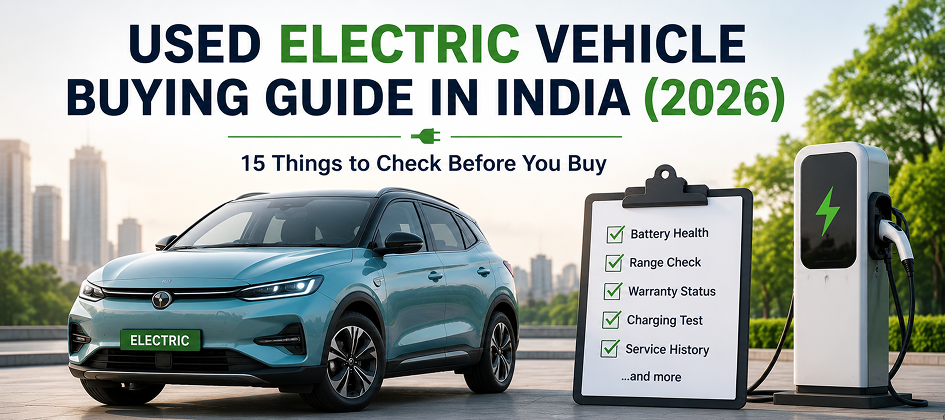
Use this practical checklist when inspecting a pre-owned EV:
| Battery Check | What to Verify | Status |
| Battery Health | Request official diagnostic report & State of Health (SoH) | ☐ |
| Range | Perform real-world consumption test drive | ☐ |
| Charging | Verify AC slow and DC fast charging operation | ☐ |
| Warranty | Confirm remaining years, km limit, & transfer terms | ☐ |
| Warning Lights | Ensure no high-voltage or BMS fault icons are displayed. | ☐ |
| Service History | Review documented high-voltage service & update logs | ☐ |
| Repairs | Check for authorized past battery/module work | ☐ |
| Charging Cable | Inspect portable charging cable & physical connectors | ☐ |
| Professional Inspection | Schedule comprehensive technician scan & underbody check | ☐ |
Diagnostic Report ➔ SoH ➔ Real-World Range ➔ Charging Test ➔ Warranty ➔ Warning Messages ➔ Service History ➔ Professional Inspection
Evaluating battery health is the most critical step when purchasing a pre-owned electric vehicle. Never judge a used EV's battery condition from the dashboard battery percentage alone. Combine battery diagnostics, real-world range checks, charging tests, warranty information, and a professional technician's inspection before making your final buying decision.


Manage reminders, payment status, and renewal dates from one simple app.


Trusted by policyholders to track every renewal.